Disk Utility can find and repair errors related to the formatting and directory structure of a Mac disk. Errors can lead to unexpected behaviour when using your Mac, and significant errors might even prevent your Mac from starting up completely.
Download Bootdisk Utility - Create bootable USB disks with your favorite MAC OSX distribution and latest Clover bootloader by turning to this lightweight application. Now I need Disk Utility (or so I believe) to repair permissions on my drive and get me back to my mac-filled bliss. Which brings me back to the main question: Where can I download it? Whether you've read the short or the long, I hope you can point me in a good direction, or help me in some way. Our website provides a free download of RAM Disk Utility Pro 1.3 for Mac. The most popular version among the application users is 1.2. This application is compatible with Mac OS X 10.4.0 or later. Our built-in antivirus checked this Mac download and rated it as 100% safe. The application lies within System Tools, more precisely System Optimization.
Before proceeding, make sure you have a current backup of your Mac, in case you need to recover damaged files or Disk Utility finds errors that it can't repair.
Open Disk Utility
In general, you can just open Disk Utility from the Utilities folder of your Applications folder. However, if your Mac doesn't start up completely or you want to repair the disk your Mac starts up from, open Disk Utility from macOS Recovery:
- Determine whether you're using a Mac with Apple silicon, then follow the appropriate steps:
- Apple silicon: Turn on your Mac and continue to press and hold the power button until you see the startup options window. Click the gear icon labelled Options, then click Continue.
- Intel processor: Turn on your Mac, then immediately press and hold these two keys until you see an Apple logo or other image: Command (⌘) and R.
- You may be asked to select a user you know the password for. Select the user, then click Next and enter their administrator password.
- From the utilities window in macOS Recovery, select Disk Utility and click Continue.
Select your disk in Disk Utility
Choose View > Show All Devices (if available) from the menu bar or toolbar in Disk Utility.
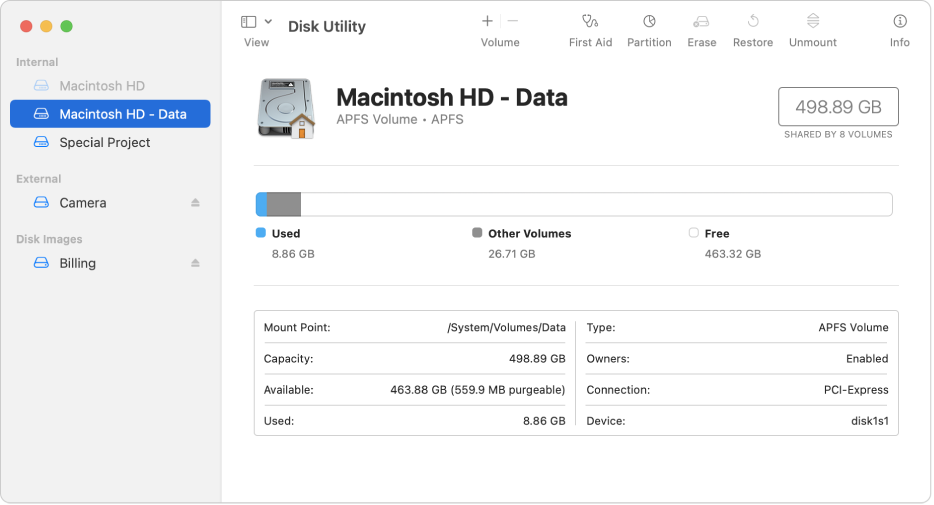
The sidebar in Disk Utility should now show each available disk or other storage device, beginning with your startup disk. And beneath each disk you should see any containers and volumes on that disk. Can't see your disk?
In this example, the startup disk (APPLE HDD) has one container and two volumes (Macintosh HD, Macintosh HD - Data). Your disk might not have a container and it might have a different number of volumes.
Repair volumes, then containers, then disks
For each disk that you're repairing, start by selecting the last volume on that disk, then click the First Aid button or tab.
In this example, the last volume on the disk is Macintosh HD - Data.
Click Run to begin checking the selected volume for errors.
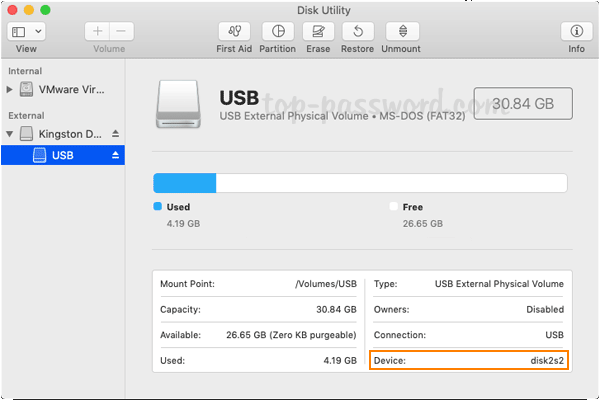
- If there is no Run button, click the Repair Disk button instead.
- If the button is dimmed and you can't click it, skip this step for the disk, container or volume you selected.
- If you're asked for a password to unlock the disk, enter your administrator password.
After Disk Utility has finished checking the volume, select the next item above it in the sidebar, then run First Aid again. Keep moving up the list, running First Aid for each volume on the disk, then each container on the disk, then finally the disk itself.
Download Mac Disk Utility For Windows
In this example, the repair order is Macintosh HD - Data, then Macintosh HD, then Container disk3, then APPLE HDD.
If Disk Utility found errors that it can't repair
If Disk Utility found errors that it could not repair, use Disk Utility to erase (format) your disk.
If your disk doesn't appear in Disk Utility
Boot Disk Utility Mac Download
If Disk Utility can't see your disk, it also can't see any containers or volumes on that disk. In that case, follow these steps:
Disc Utility Download Mac Os X
- Shut down your Mac, then unplug all non-essential devices from your Mac.
- If you're repairing an external drive, make sure it's connected directly to your Mac using a cable that you know is good. Then turn the drive off and back on.
- If your disk still doesn't appear in Disk Utility, your Mac might need service. If you need help, please contact Apple Support.